

Imagine it’s Monday morning. You log into your weekly team meeting and see a new name on the participant list: “Aiden.” Over the weekend, Aiden has analyzed every competitor’s social media post, drafted 50 variations of ad copy for the new campaign, and summarized a 200-page market research report into five actionable bullet points. Aiden never sleeps, never takes a coffee break, and has a near-perfect memory of every piece of data your company has ever produced. Aiden, of course, is an AI.
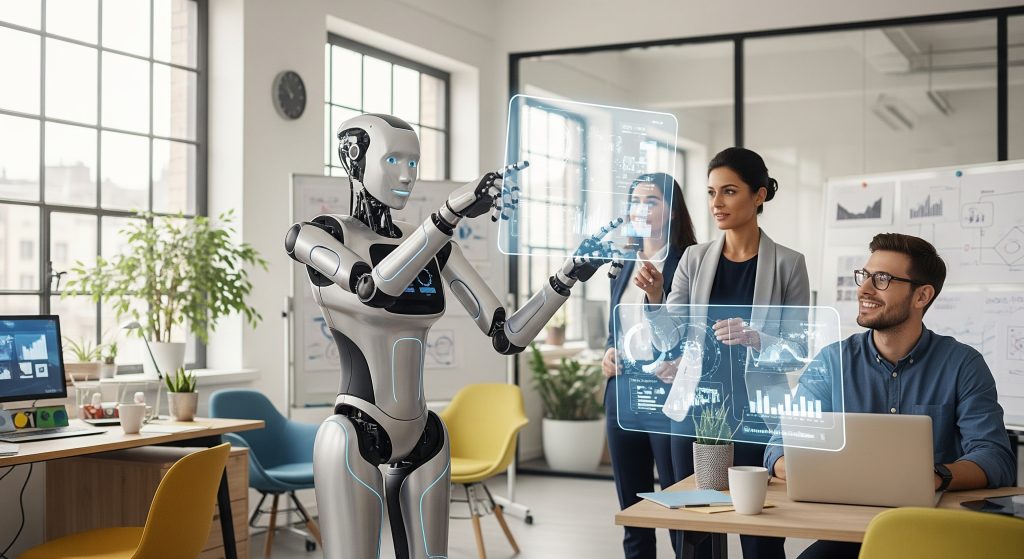
For years, we’ve talked about artificial intelligence as a “tool”—a sophisticated piece of software we command. But the rapid evolution of AI agents is forcing a fundamental paradigm shift. We are moving from using passive tools to integrating semi-autonomous teammates. The most forward-thinking companies are no longer just using AI; they are learning to manage it.
This isn’t a futuristic fantasy; it’s the next frontier of leadership and productivity. Success no longer depends on just having access to AI, but on how well you can onboard, direct, and collaborate with these new digital employees. Here is a practical framework for doing just that.
Part 1: The Mindset Shift—From Tool to Teammate
The first step is to change how we think about AI. A tool, like a hammer or Adobe Photoshop, is passive. It does exactly what you tell it, and nothing more. A teammate, however, has a degree of autonomy. You give them a goal, and they use their own capabilities to figure out the steps to get there.
Think of your new AI agent not as a magical black box, but as a hyper-efficient, highly knowledgeable junior employee or intern.
- It has immense raw capability but lacks context.
- It needs clear direction and specific goals.
- It learns from feedback and gets better with experience.
- It has clear strengths (speed, data analysis) and weaknesses (emotional nuance, true creativity).
Adopting this “digital co-worker” mindset is crucial because it frames the relationship correctly. You don’t just command it; you cultivate it.
Part 2: How to MANAGE Your Digital Employee
Like any team member, an AI needs structure and oversight to be effective.
1. Define the Job Description:
Before you integrate an AI, be specific about its role. Is it a “Data Analyst AI,” tasked with monitoring dashboards and flagging anomalies? A “Content Creator AI,” responsible for writing first drafts of blog posts and social media updates? Or a “Customer Support AI,” handling Tier-1 inquiries? Giving it a clear title and a defined “job description” prevents it from being a novelty and turns it into a functional part of the team.
2. Set Clear Goals and KPIs (Key Performance Indicators):
How do you know if your AI is doing a good job? Its performance must be measurable.
- For a Content AI: Success could be measured by a reduction in human editing time by 40%, an increase in content output by 200%, or achieving a certain quality score on its first drafts.
- For a Data AI: KPIs could include the speed and accuracy of weekly reports, or the number of previously unseen, actionable insights it identifies from sales data.
3. Integrate it into the Team Workflow:
Your AI needs a place in the virtual office. Who is its “manager”? How does it “communicate” its work? Successful teams often create a dedicated Slack or Teams channel where the AI reports its findings, submits its drafts, or asks for clarification. This makes its contributions visible and integrates it seamlessly into daily operations.
Part 3: How to TRAIN Your Digital Employee
An out-of-the-box AI is a blank slate. Its real value is unlocked through dedicated training and “onboarding.”
1. Feed it the “Company Brain”:
The single most important step is to train the AI on your proprietary data. This means feeding it your entire “company brain”:
- Internal Documents: Strategy memos, project plans, meeting minutes.
- Past Work: Successful marketing campaigns, old blog posts, sales presentations.
- Brand Guidelines: Style guides, tone-of-voice documents.
- Customer Data: Anonymized customer service chats, feedback forms, product reviews.
This is how an AI moves from giving generic answers to providing context-aware insights in your company’s unique voice.
2. Develop a “Prompt Library”:
A prompt is a directive given to an AI. A “Prompt Library” is a shared, internal repository of highly effective, reusable prompts for common tasks. This is the equivalent of creating Standard Operating Procedures (SOPs) for your digital employee. Instead of each team member trying to invent the perfect prompt every time, they can pull from a refined, battle-tested playbook, ensuring consistency and high-quality output.
3. Provide Continuous Feedback:
AI models learn through reinforcement. When your AI delivers a great response, use the “thumbs up” or provide positive feedback. When it makes a mistake, correct it. This iterative process is the AI equivalent of a continuous performance review. The AI you have in Month 6 should be exponentially more valuable than the one you started with, but only if you consistently train it.
Part 4: How to COLLABORATE with Your Digital Employee
AI is not a replacement for human talent; it’s an amplifier. The most groundbreaking results come from a symbiotic partnership between human and machine.
1. Divide Labor Based on Strengths:
The key to effective collaboration is assigning the right task to the right mind—whether biological or digital.
- Delegate to AI: Tasks requiring speed, scale, data processing, and variation generation. (e.g., “Analyze these 10,000 customer reviews and group them by sentiment,” or “Write 50 different headlines for this article.”)
- Retain for Humans: Tasks requiring strategic vision, emotional intelligence, ethical judgment, complex problem-solving, and building relationships. (e.g., “Based on the AI’s analysis, which customer complaint should we address first to protect our brand reputation?”)
2. Cultivate the New “Superpower” Skill: Strategic Prompting and Critical Oversight:
In this new paradigm, the most valuable human skills are not about having all the answers, but about knowing how to ask the right questions. “Prompt engineering”—the art of crafting effective directives for an AI—is a critical skill. Equally important is the ability to critically evaluate, question, and refine the AI’s output. The human role shifts from “creator of the first draft” to “director and editor-in-chief.”
Conclusion: The Rise of the AI Manager
The conversation is no longer if AI will be a part of our work, but how deeply it will be integrated. Companies that treat AI as just another software tool will be quickly outmaneuvered by those who cultivate it as a core part of the team.
This requires a new type of leader: one who is as comfortable directing a digital employee as they are mentoring a human one. They will be the architects of hybrid teams, the trainers of custom AI models, and the conductors of a symphony of human and machine intelligence. The future of work isn’t about humans vs. AI; it’s about the companies with the best human-AI teams. And leadership for that future begins now.