

Look at your calendar. It’s likely a perfectly arranged mosaic of meetings, deadlines, and reminders—a testament to your efficiency. Your inbox is a battlefield where you valiantly fight for “inbox zero.” Every spare moment, from the elevator ride to the queue for coffee, is an opportunity to be optimized with a podcast, a newsletter, or a quick email check. We live in the era of the “productivity hack,” a time where being busy is a status symbol and an empty schedule is seen as a sign of weakness.
In our relentless, almost religious pursuit of efficiency, we’ve become experts at filling every second with a task. But what if the most valuable resource we’re sacrificing is the very thing that looks like its opposite: boredom? What if, in our war against idleness, we are inadvertently destroying our greatest source of innovation?
This isn’t a call for laziness. It’s an economic argument. Strategically embracing “doing nothing” is not a luxury; it is a profound competitive advantage, and quite possibly the most undervalued asset in business today.
The Modern War on Boredom
We exist within an “Attention Economy,” where our focus is the world’s most sought-after commodity. Digital platforms are engineered to eliminate every moment of quiet contemplation. “Hustle culture” glorifies a state of perpetual motion, rewarding performative busyness over thoughtful progress. The result is a workforce optimized for “shallow work”—the constant stream of responding, reacting, and ticking off small tasks.
This relentless activity creates the illusion of productivity. We feel accomplished because we were busy all day, but we’ve merely been spinning the wheels faster. We’ve left no room for the deeper, more cognitively demanding tasks that lead to breakthroughs: strategic thinking, creative problem-solving, and genuine innovation. We have successfully engineered boredom out of our lives, and in doing so, we’ve paved over the fertile ground where our best ideas are born.
The Neuroscience of a Wandering Mind
To understand the value of boredom, we need to look inside our own brains. When we are not actively focused on a specific, external goal (like reading an email or listening to a presentation), our brain switches into a fascinating and crucial state known as the Default Mode Network (DMN).
Think of the DMN as your brain’s “creative incubator.” It’s the neurological basis for daydreaming and mind-wandering. When the DMN is active, our brain isn’t idle at all. It’s working diligently in the background, doing three critical things:
- Connecting the Past: It sifts through our memories, linking past experiences to our present challenges.
- Simulating the Future: It runs scenarios and helps us set long-term, meaningful goals.
- Synthesizing Ideas: Most importantly, it makes novel connections between disparate ideas that are already stored in our mind. This is the neurological source of the “aha!” moment—the sudden, brilliant insight that seems to come from nowhere.
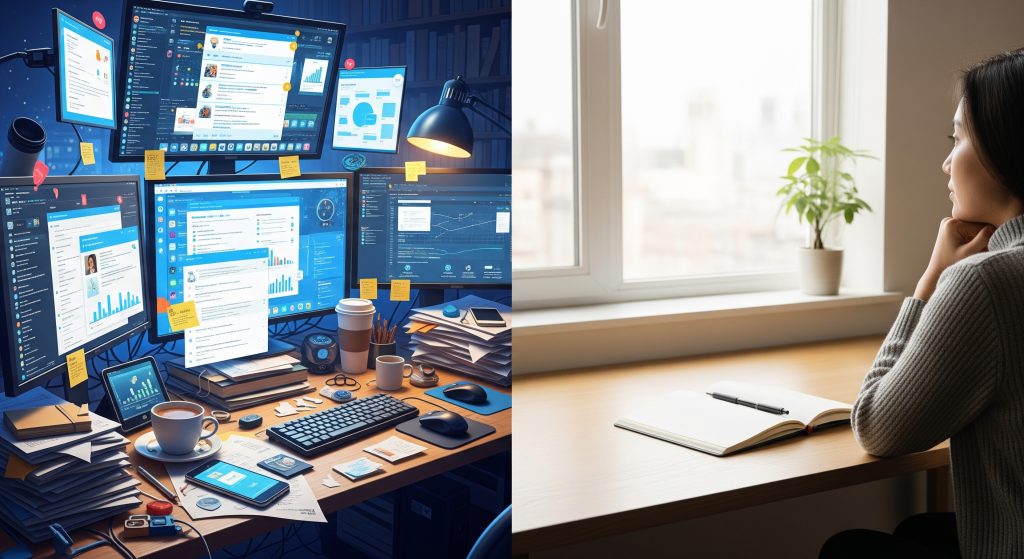
When we fill every moment with external stimuli, we prevent the DMN from ever activating. We deny our brain the dedicated time it needs to do its most profound work. True creativity doesn’t happen when you’re staring at a spreadsheet; it happens when you’re staring out the window after you’ve finished with the spreadsheet.
Lessons from History: The Power of the Unscheduled Life
History is filled with great thinkers whose breakthroughs were born not from intense, focused work, but from periods of idleness and contemplation.
- Albert Einstein famously developed his theory of special relativity while working a mundane job at a Swiss patent office. The routine nature of his work left his mind free to wander, famously imagining what it would be like to ride on a beam of light.
- The French mathematician Henri Poincaré described solving a complex problem not by forcing it, but by going on a geological excursion. The solution came to him, fully formed, as he was stepping onto a bus, precisely at the moment he was not thinking about it.
- In the modern era, leaders from Jeff Bezos to Bill Gates are known for scheduling “think weeks”—periods of total disconnection dedicated to reading and contemplation. The principle remains the same: the quality of your focused work is determined by the quality of your unfocused time.
The Practical Guide to “Structured Boredom”
Reclaiming boredom doesn’t mean becoming unproductive. It means being intentional about creating space for deep thought.
For Individuals:
- Schedule “Do Nothing” Time: Block out 30 minutes in your calendar with no agenda. No phone, no computer. Go for a walk without a podcast. Sit in a park. Let your mind drift.
- Embrace Mundane Tasks: Use chores like washing dishes, folding laundry, or taking a shower as protected time for your DMN to activate. Some of our best ideas come when our hands are busy but our minds are free.
- Practice “Input Deprivation”: Deliberately choose to drive without the radio or sit in a waiting room without looking at your phone. Let your mind get bored. It will thank you for it later.
For Leaders and Companies:
- De-stigmatize Downtime: Encourage employees to take real, screen-free breaks. A culture that celebrates employees eating lunch at their desks is a culture that stifles innovation.
- Re-engineer Meeting Culture: Shorten all meetings by 10 minutes to give people a mental buffer zone. A day of back-to-back meetings is the enemy of progress.
- Create Spaces for Contemplation: Design offices with quiet rooms, walking paths, or comfortable nooks intentionally free of screens and distractions.
Conclusion: Your Most Valuable Asset
The modern economy rewards us for being responsive, for being available, for being busy. But the future will belong to those who cultivate the discipline to resist this. True, game-changing breakthroughs don’t emerge from a flurry of activity; they arise from the quiet, contemplative space that we have tried so hard to eliminate.
Boredom is not an absence of value. It is the very condition required for our brains to synthesize, create, and solve our most important problems. In a world that wants to claim your every waking second, the courage to do nothing is not a weakness. It is your most powerful, and in the long run, your most profitable business asset.