

The term “quantum computing” often conjures images of science fiction—impossibly complex machines in sub-zero labs, solving problems with a power that borders on magic. It’s frequently mentioned in the same breath as AI as a world-changing technology, but unlike AI, which we now interact with daily, quantum feels abstract, impenetrable, and impossibly distant.
For a business leader, this creates a strategic dilemma. How do you prepare for a revolution you can’t fully comprehend? How do you separate the near-term, tangible impact from the far-future, speculative hype? Ignoring it feels negligent, yet investing in it feels like a gamble on a mystery.
This article is not for physicists. It is a strategic briefing for leaders. We will bypass the confounding quantum mechanics to focus on three critical questions: 1) In simple terms, what is it? 2) Which industries will it disrupt first? and 3) What should you actually be doing about it now?
Part 1: What Is Quantum Computing? (The 5-Minute MBA Explanation)
To understand the business implications, you don’t need to understand the physics, but you do need to grasp one fundamental difference.
A classical computer, the kind on your desk and in your phone, thinks in bits. A bit is like a light switch: it can be either ON (represented by a 1) or OFF (represented by a 0). It’s a binary, black-or-white world. All the incredible complexity of modern computing is built on billions of these simple, definite switches.
A quantum computer thinks in qubits. A qubit is not a light switch; it’s more like a dimmer switch. It can be ON, OFF, or—crucially—somewhere in between at the same time. This “in-between” state is a core quantum principle called superposition. Think of a spinning coin: until it lands, it is simultaneously heads and tails. A qubit holds that kind of probabilistic, multi-state potential.
This leads to a quantum superpower. Because a qubit can explore multiple values at once, a quantum computer with just a few hundred qubits can explore a problem space with more possible states than there are atoms in the known universe. It’s like being able to check every single room in a gigantic maze simultaneously, instead of one by one.
The Key Takeaway for Leaders: Quantum computers will not replace your laptop. They are not simply faster versions of current machines. They are a fundamentally different kind of tool, like a specialized piece of industrial machinery, designed to solve a very specific class of problems currently impossible for even the most powerful supercomputers on Earth.
Part 2: The Disruption Zone: Which Industries Will Be Impacted First?
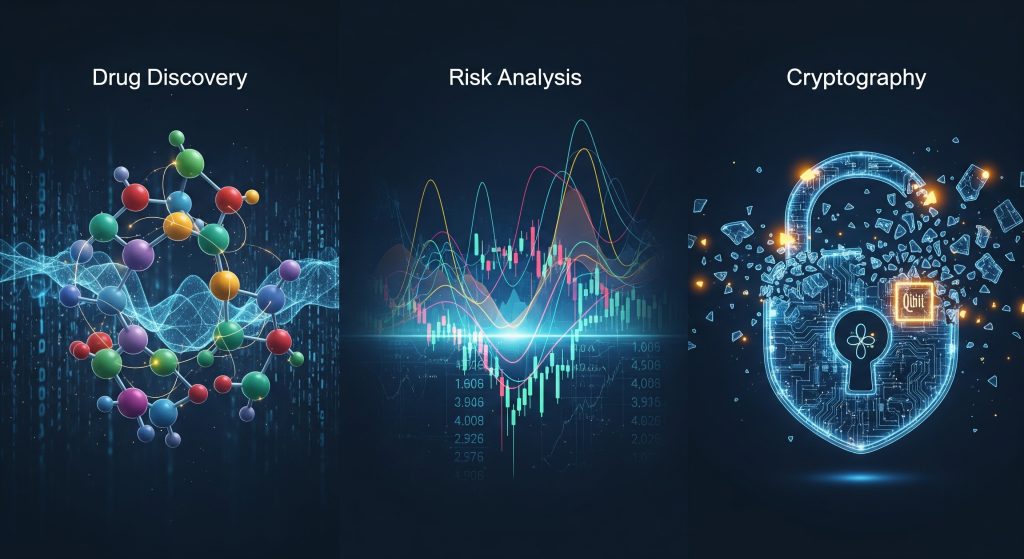
Quantum computing’s impact won’t be uniform. It will be a tidal wave in some sectors and a distant ripple in others. Here are the industries on the front line.
A) Pharmaceuticals & Materials Science (The Discovery Engine)
- The Problem: Designing new drugs and advanced materials requires simulating how molecules will behave. Molecules are complex quantum systems, and accurately modeling them is incredibly difficult for classical computers.
- The Quantum Solution: A quantum computer is the perfect tool to simulate a quantum system. It can model molecular interactions with perfect accuracy, something that is impossible today.
- The Business Impact: This will dramatically accelerate drug discovery, allowing companies to design hyper-personalized medicines. It will enable the creation of revolutionary new materials, leading to ultra-efficient batteries, new catalysts for green energy, and stronger, lighter components for manufacturing. The first company to design a blockbuster drug using a quantum computer will have an insurmountable advantage.
B) Finance & Logistics (The Optimization Engine)
- The Problem: Many of the hardest problems in business are optimization problems: finding the best investment portfolio out of trillions of options, calculating the most efficient shipping routes for a global logistics network, or pricing complex financial derivatives.
- The Quantum Solution: Quantum computers are uniquely suited to sifting through a vast number of possibilities to find the optimal solution.
- The Business Impact: This will lead to ultra-accurate financial risk models, new algorithmic trading strategies that can analyze markets in entirely new ways, and hyper-optimized supply chains that can save companies billions in operational costs.
C) Cryptography & Cybersecurity (The Code Breaker)
- The Problem: The security that protects most of the world’s data—from bank accounts to state secrets—is built on the fact that it is incredibly difficult for classical computers to factor very large numbers.
- The Quantum Threat: This is the double-edged sword. A sufficiently powerful quantum computer could, in theory, break this encryption with ease, rendering much of our current digital infrastructure insecure. This is often called the “quantum apocalypse.”
- The Business Impact: This is both a massive threat and a monumental opportunity. A race is now underway to develop “quantum-resistant” cryptography. Any business handling sensitive, long-term data (finance, healthcare, government) must consider that information encrypted today could be vulnerable to decryption by a future quantum computer.
Part 3: Your Quantum Strategy: What to Do Now (and What Not to Do)
Given the long-term timeline, how should a pragmatic leader act today?
What NOT to Do:
- Don’t Panic: A quantum computer capable of breaking mainstream encryption is likely still years, if not a decade or more, away. The immediate threat is not imminent.
- Don’t Rush to “Buy a Quantum Computer”: They are not general-purpose machines you can put in a server room. For the foreseeable future, access will be via cloud platforms for specialized research.
What TO Do:
- Become “Quantum-Aware”: The first step is education. Assign a person or a small team to monitor developments in the quantum space. Circulate high-level briefings. The goal is not to become experts, but to understand the trajectory of the technology and its potential impact on your industry.
- Identify Your “Quantum-Vulnerable” Problems: Analyze your business. Are you a pharmaceutical company whose R&D process could be transformed? A financial firm built on complex risk modeling? Does your business depend on the long-term security of encrypted data? Know where the quantum wave will hit your shoreline first.
- Encourage Experimentation (via the Cloud): Major players like IBM, Google, and Amazon already offer access to their early-stage quantum computers via their cloud services (Quantum-as-a-Service, or QaaS). Encourage your R&D or advanced data science teams to start experimenting. Let them learn the new programming paradigms and begin exploring how quantum algorithms could be applied to your specific business challenges.
- Plan Your Post-Quantum Security Transition: If you are in a high-stakes industry, this is the most urgent action. Start a strategic conversation with your CISO and cybersecurity teams about a roadmap for migrating to quantum-resistant cryptographic standards. This is a long and complex process that should be planned years in advance.
Conclusion: Preparing for a Different Kind of Future
Quantum computing is no longer the stuff of science fiction. While it won’t be replacing your employees’ laptops for sending emails, it represents a fundamental shift in computational power that will redefine entire industries by making the impossible, possible.
For leaders today, the objective is not to become a quantum physicist. It is to develop strategic foresight. Like the dawn of classical computing or the commercial internet, the early days of this revolution will be defined by learning and preparation. The companies that start building their awareness and capabilities today will be the ones that hold the quantum advantage tomorrow.