
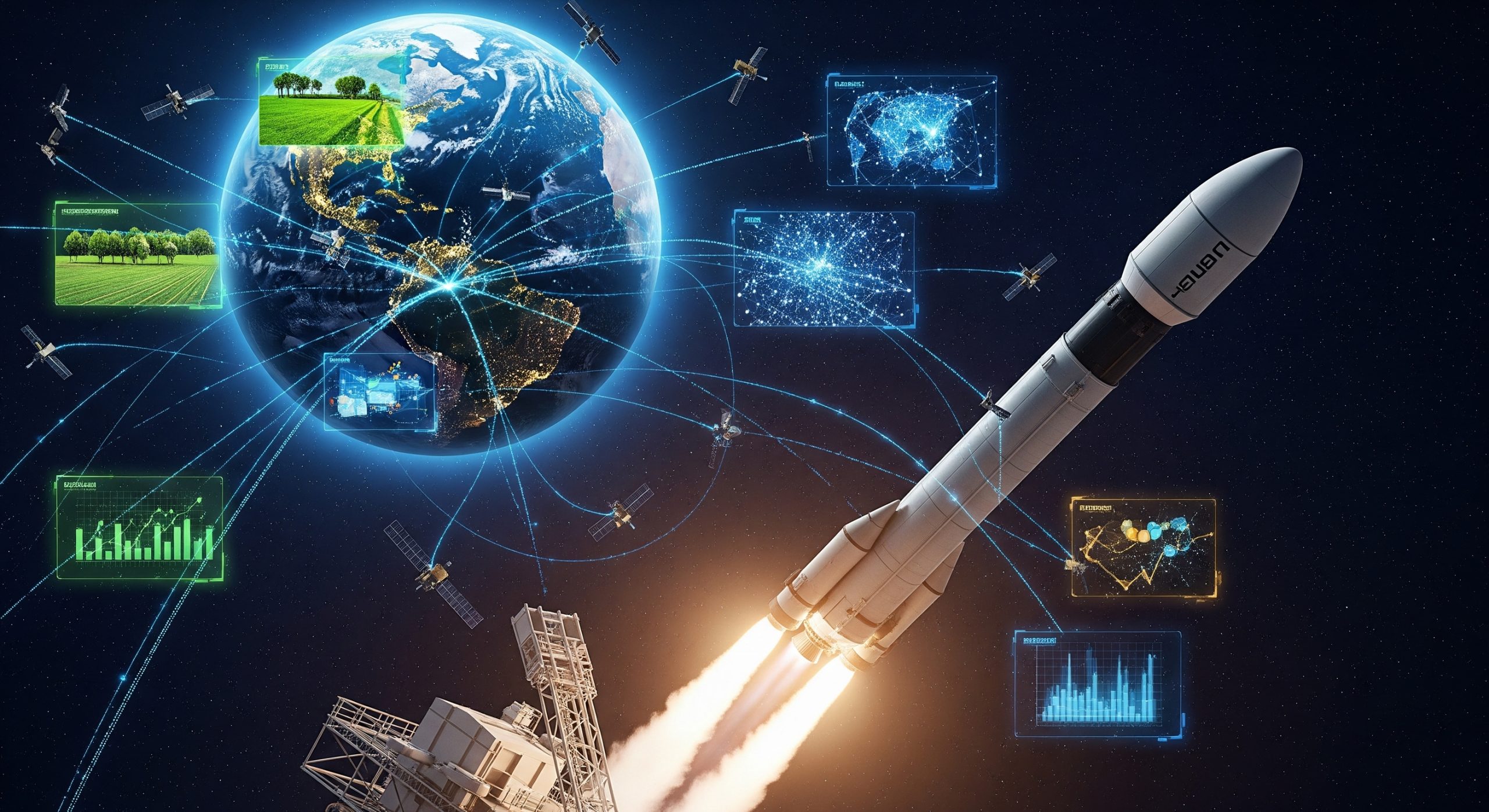
When a sleek, reusable rocket like SpaceX’s Falcon 9 gracefully descends from the heavens to land perfectly on a drone ship, it’s easy to dismiss it as a magnificent, yet extravagant, spectacle. The headlines are dominated by a handful of billionaires, and the immediate reaction is often a cynical question: “Is this just an expensive hobby for the ultra-rich while there are so many problems to solve on Earth?”
It’s a fair question, but one that misses the bigger picture. Beneath the spectacle of launches and landings lies one of the most significant engines of innovation of our time. The new space race, led by private companies, is not just about reaching for the stars; it’s about fundamentally changing life on the ground. The true breakthroughs aren’t just happening in orbit; they are quietly revolutionizing industries, creating new markets, and providing powerful tools to solve some of Earth’s most pressing challenges.
The Engine of Innovation: The Collapse of Launch Costs
To understand why this is happening now, you need to understand one transformative concept: the radical collapse of the cost to access space.
For decades, space exploration was the exclusive domain of governments. It was built on the model of single-use rockets, like the Saturn V or the Space Shuttle’s components. Imagine buying a brand-new Boeing 747 for a single flight from New York to London and then throwing it away. That was the economic reality of space travel—prohibitively expensive and monumentally inefficient.
The revolution, pioneered and perfected by companies like SpaceX and followed by others like Rocket Lab, is reusability. By designing first-stage rocket boosters that can return to Earth and be flown again and again, they have shattered the old economic model. The cost to launch one kilogram of payload into Low Earth Orbit (LEO) has plummeted by over 90% in the last decade alone.
This isn’t just an incremental improvement; it’s a “Big Bang” event for the space industry. This drastic cost reduction has, for the first time in history, made thousands of new space-based business models economically viable. It has opened the floodgates for a wave of innovation that is now washing back down to Earth.
Down-to-Earth Breakthroughs: The Spin-Off Economy
The practical benefits of this new era are not theoretical; they are already being implemented across critical sectors of our economy.
1. Connecting the Unconnected: A New Global Internet
For billions of people in rural and remote areas, high-speed internet has been a distant dream. Laying fiber-optic cables to small communities is often economically unfeasible. This is where mega-constellations of satellites in Low Earth Orbit, like SpaceX’s Starlink and Amazon’s Project Kuiper, are becoming game-changers.
By deploying thousands of small, relatively inexpensive satellites, these networks can beam high-speed internet to virtually any point on the globe.
- Real-world impact: This is a lifeline for remote schools, enabling distance learning. It allows for advanced telehealth services in underserved communities. It empowers entrepreneurs in developing nations to access global markets. For disaster relief operations, where ground infrastructure is destroyed, it provides an instant communication backbone.
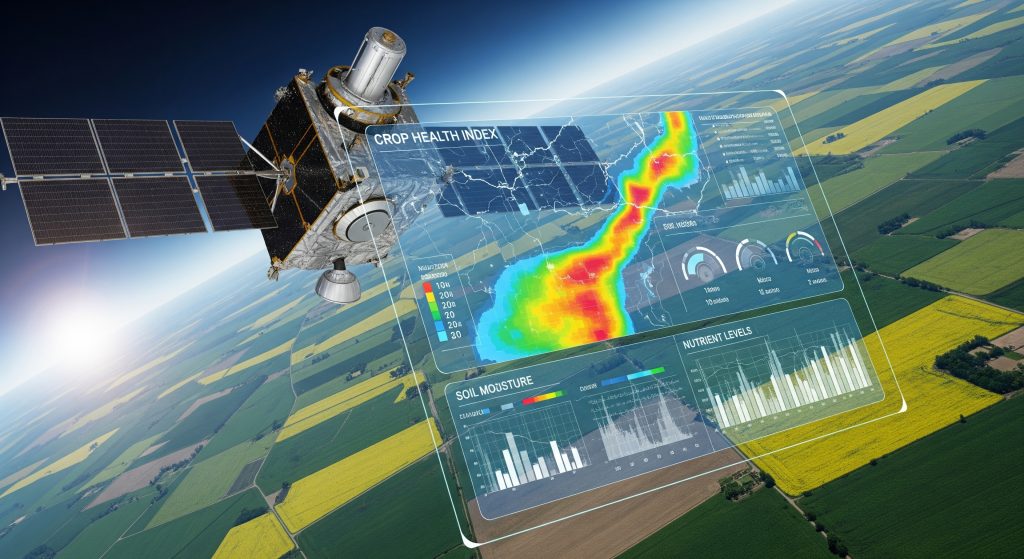
2. A Planet Under a Magnifying Glass: Earth Observation & Data
We are gaining an unprecedented understanding of our own planet, thanks to constellations of small, powerful imaging satellites. Companies like Planet Labs and Maxar Technologies now image the entire landmass of Earth on a daily basis, creating a searchable, visual index of planetary change.
This “living map” is fueling data-driven revolutions in countless industries:
- Precision Agriculture: Farmers can monitor the health of individual fields from space, using data to apply water and fertilizer with surgical precision. This increases crop yields, reduces costs, and minimizes environmental impact.
- Climate Science: Scientists can now track deforestation, polar ice melt, and illegal mining operations in near real-time, providing irrefutable data to guide policy and conservation efforts.
- Finance & Insurance: Hedge funds analyze satellite imagery of retail parking lots to predict quarterly earnings, while insurance companies assess damage from natural disasters more quickly and accurately than ever before.
3. The Future is Lighter and Stronger: Advanced Materials & Manufacturing
Building a rocket is one of the most extreme engineering challenges in existence. Materials must withstand incredible temperatures and pressures while being as lightweight as possible. To solve these problems, space companies are at the forefront of materials science and manufacturing.
Techniques like 3D-printing advanced metal alloys (as seen in the Raptor engines) and the development of next-generation carbon composites are essential for building reusable rockets.
- Real-world impact: These innovations are directly transferable. The automotive and aviation industries are adopting these materials to build lighter, more fuel-efficient vehicles. The same 3D-printing techniques are being used to create stronger, custom-fitted medical implants.
4. Healthcare in Zero-G: Breakthroughs in Medicine
Microgravity provides a unique laboratory environment, free from the distorting pull of Earth’s gravity. The increasing frequency and affordability of launches are making it a viable platform for medical research.
- Real-world impact: In space, protein crystals—which are key to understanding diseases—can be grown larger and more perfectly. This allows scientists to better understand their structure and design more effective drugs to combat illnesses like cancer and muscular dystrophy. Furthermore, the compact, robust sensors developed to monitor astronauts’ health are being adapted for terrestrial use in remote patient monitoring and wearable health tech.
Conclusion: An Investment in Our Own Planet
The narrative of the private space race as a billionaire’s vanity project is compelling, but it’s ultimately a distraction from the real story. Every successful launch and every landed rocket booster reinforces an economic cycle that drives profound innovation back on Earth.
The dramatic reduction in launch costs has democratized access to space, turning it from a government-run spectacle into a dynamic platform for enterprise. The result is a more connected, better-understood, and technologically advanced world. The ultimate value of reaching for the stars may be the unexpected and powerful ways in which it forces us to improve life on the ground. The billionaires may be writing the checks, but humanity as a whole is reaping the rewards.