

We live in an era where speed is no longer a convenience—it is a culture, an expectation, a silent rule that governs the rhythm of our days. Technology has not simply accelerated our tools; it has accelerated us. We respond before we think, we decide before we understand, we consume before we feel. In the architecture of digital life, speed has replaced depth, reaction has replaced reflection, and immediacy has replaced meaning. Yet speed is not neutral. It shapes how we work, how we relate to others, how we perceive ourselves, and ultimately how we experience reality. The ethics of speed is not a technical debate; it is a human one. And to understand it, we must first recognize the invisible forces that make acceleration feel inevitable—and the profound cost of letting those forces govern our lives.
I. The Culture of Acceleration
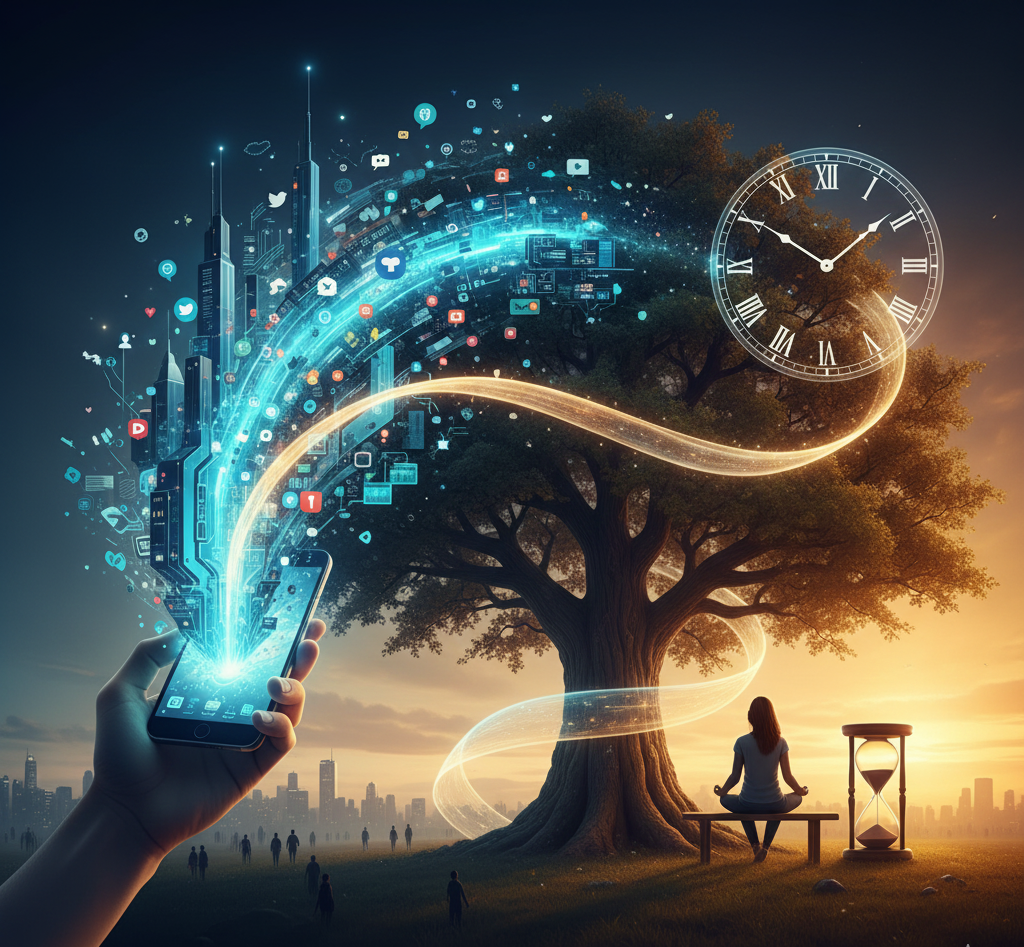
Acceleration has become the invisible ideology of the modern world. We rarely question it because it feels natural, almost inevitable. Smartphones wake us before we fully inhabit consciousness. Content scrolls faster than our emotions can catch up. Tasks pile up not because they are meaningful, but because we have created systems that reward movement over intention. The speed of digital life has infiltrated every space: work, relationships, learning, even rest. We measure value in instant replies, rapid progress, uninterrupted availability. To be slow is to risk being left behind, misunderstood, or perceived as inefficient. But the culture of acceleration is not just about pace—it is about pressure. A pressure that compresses our time into fragments, pushes us toward constant productivity, and subtly rewrites our emotional landscape. Under the rule of speed, silence becomes uncomfortable, pauses feel suspicious, waiting is intolerable. The faster we live, the less space we leave for the organic rhythms of thought, emotion, and human connection. And as speed becomes normalized, we begin to mistake urgency for importance, motion for meaning, acceleration for advancement. We forget that the most transformative aspects of life—creativity, intimacy, insight—cannot be rushed.
II. The Cognitive Cost of Instant Everything
The human brain evolved in centuries of slowness: long cycles of attention, deep concentration, meandering contemplation. The digital environment, however, is built on micro-interruptions. Notifications, feeds, algorithmic nudges—each one designed to fragment attention into consumable units. The cost of this fragmentation is profound. When everything arrives instantly, our cognitive patterns shift. We begin to crave velocity itself, not the content it delivers. We skim instead of read, react instead of analyze, absorb instead of reflect. The brain becomes conditioned to rapid transitions and develops impatience toward any stimulus that requires sustained focus. This is not merely psychological erosion. It is existential thinning. Our inner life becomes shallower, less textured. Ideas lose complexity. Emotions lose duration. Curiosity becomes fragile. Incessant speed creates an internal short-circuiting: a mind trained to expect constant stimulation is a mind unable to stay with discomfort, depth, or ambiguity. And ambiguity—slow, demanding, unresolved—is the birthplace of real thinking. Without cognitive stillness, we lose not only attention, but also imagination. A fast mind is efficient, but an efficient mind is not necessarily wise.
III. The Moral Dimension of Time
Time is the fabric of human meaning. How we spend it reveals who we are; how we protect it reveals what we value. The ethics of speed forces us to confront a question we rarely ask: What does our use of time say about our priorities? Speed promises freedom, yet often imposes the opposite. We optimize our schedules only to fill them further. We automate tasks only to accept more. We collapse distances only to increase demands. Time saved becomes time immediately consumed. This paradox exposes a moral contradiction at the heart of acceleration: we have more tools to free our time than any generation in history, and yet we feel more time-poor than ever. Why? Because acceleration changes our relationship with time itself. Slowness becomes equated with laziness. Pausing becomes inefficiency. Choosing to unplug becomes an act of rebellion. But behind this lies a deeper truth: slowness is not simply a pace—it is a stance toward life. It is the capacity to choose, to prioritize, to be intentional rather than reactive. It is the courage to protect moments that cannot be measured by productivity. Ethical time is time owned, not time dictated. And in a society ruled by speed, reclaiming time becomes a moral act.
IV. Real-Time Living and the Illusion of Presence
The promise of real-time technology is seductive: instant connection, seamless communication, uninterrupted awareness. But real-time living is often an illusion. Presence becomes divided, attention becomes partial, and interactions become mediated rather than lived. To be always reachable is not the same as being truly present. To respond instantly is not the same as listening. To share continually is not the same as feeling. The digital world amplifies visibility but diminishes intimacy. We document experiences before inhabiting them. We seek micro-validation rather than genuine connection. We monitor our lives through screens, losing the tactile, sensory richness of the physical moment. Real-time culture teaches us to exist in perpetual anticipation—always waiting for the next update, the next message, the next moment of relevance. The result is a form of psychological displacement: we are everywhere but nowhere, connected to all but bonded to few. In the ethics of presence, the question becomes: If everything demands our attention, does anything truly receive it? To reclaim presence, we must resist the temptation of split existence. We must learn to experience life at the speed of humanity, not at the speed of data.ù
V. Toward a Conscious Experience of Time
At Redation, we believe the future of digital life cannot be built on acceleration alone. Technology must be guided by intention—not momentum. Conscious time is not a manifesto for slowness; it is an invitation to choose our pace with awareness. To move fast when it serves meaning, and to slow down when depth demands it. Conscious time honors the value of stillness, the necessity of reflection, the dignity of deliberate action. It restores the human dimension to a world increasingly dominated by systems optimized for speed rather than understanding. Living consciously means giving time a narrative again—allowing moments to stretch, emotions to mature, thoughts to unfold. It means replacing reaction with interpretation, velocity with purpose, productivity with presence. And it means recognizing that the most advanced form of intelligence—human or artificial—is not the ability to accelerate, but the ability to discern when not to. Because the question that defines our era is no longer “How fast can we go?” but “What do we lose when we forget to slow down?” The future will belong not to those who move the quickest, but to those who understand the rhythm of time, the weight of attention, and the profound human need for depth. Conscious time is not the end of speed—it is its redefinition. A reminder that technology may accelerate life, but only we can choose how fully we live it.